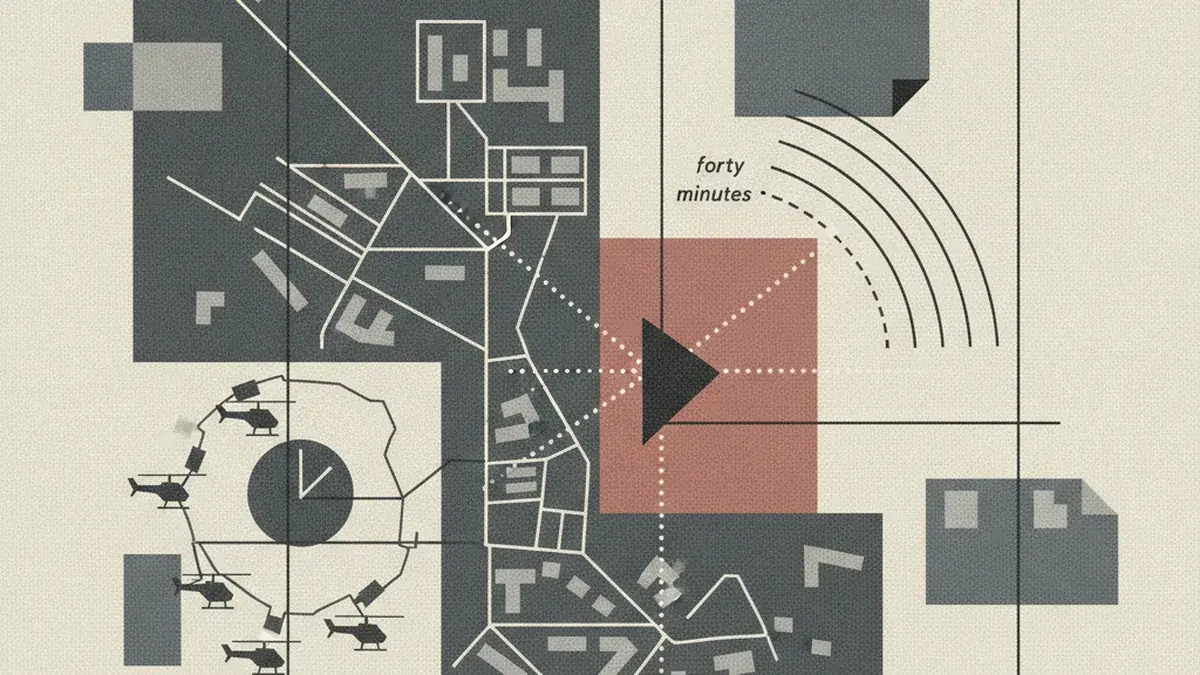
It helps to see this story laid out flat. Put end to end, it runs from the announcement of a troop surge in January 2007 to an airport in Canberra in June 2024, and the shooting itself takes up about forty minutes of it. Everything else on this page is people arguing about, hiding, releasing or punishing those forty minutes.
How to read this timeline
The full ledger sits below in date order, grouped into six stretches of time. A few notes before you start.
- Times on 12 July 2007 are approximate. They come from the recording's own clock and from the Army investigation, and they are best read as a sequence rather than as a stopwatch.
- Some entries cover a period, not a day. The freedom-of-information refusals and the extradition hearings both dragged on for years, and pretending otherwise would be tidier but less true.
- Each entry links to the page that covers it in full. This page is a map, not the territory.
The shape of the whole thing
Four numbers give you the proportions faster than any paragraph can.
What those numbers show
The violence took forty minutes. The argument about it has taken seventeen years and counting, and the part that is still unresolved is not what happened but what was done about it.
The four moments the story turns on
If you only remember four dates, make them these.
- The airstrike in Al-Amin al-Thaniyah. Two Reuters staff among the dead, two children badly wounded. The day itself.
- WikiLeaks publishes the footage in Washington and names it. The release.
- Chelsea Manning is sentenced to 35 years. The court-martial.
- Julian Assange pleads guilty to one count and goes home. The plea deal.
What a timeline like this leaves out
Two things, and both are worth saying out loud.
The families, who have no dates
The first is the families. There is no date in the ledger below for the afternoon Saeed Chmagh's children were told, or for the years afterwards. Those days exist and they are not recorded anywhere a site like this can reach. The nearest the record gets is the people page.
The things that never happened
The second is everything that did not happen. There is no entry for a criminal charge against anyone in the aircraft, because there was never one. There is no entry for the day Reuters received the footage it asked for, because that day never came either. A timeline shows you events, and some of the most important facts in this story are absences. That gap has its own page.
The long silences between the entries
Read the ledger below quickly and it looks busy. Read it properly and the gaps are the loudest part.
1: the three years before the leak
Between late July 2007, when the Army finished its investigation, and April 2010, when the footage appeared, almost nothing happens in public at all. Reuters files requests and gets nothing back. The families bury their dead. A reporter who was embedded with the same battalion publishes a book in 2009 that describes this exact attack and quotes the radio traffic, and nobody outside a small circle connects it to anything, because the recording it describes is still locked up. Nearly three years pass that way. That is the silence the leak broke.
2: when the story became about the messengers
There is a second silence after 2013. Chelsea Manning is in Fort Leavenworth, Julian Assange is in a room in an embassy in London, and the actual subject of the video, a street in eastern Baghdad on a Thursday morning, has almost entirely dropped out of the coverage. By then the story is about the messengers. Whatever you think of either of them, that drift is worth noticing, because it happened slowly enough that almost nobody objected while it was happening.
3: the silence that is still running
The third silence is still going. There has never been a date on which anyone in the aircraft or the chain of command was charged, and there is no sign there ever will be.
How this timeline is checked
Dates here come from court records, the Army investigation, contemporary news reports and the published statements of the organisations involved, cross-read against each other. Where two sources disagree, the entry uses the more conservative version and says so. Where only a month is known, only a month is given.
If you find a date here that does not match a record you have, please tell us and point at the record. A timeline is the easiest kind of page to get quietly wrong and the easiest to fix once someone notices.
The full ledger, date by date
Every dated event this archive holds, in order. Entries link to the page that covers them in full.
The surge is announced
President George W. Bush orders roughly 20,000 extra US troops into Iraq, most of them into Baghdad. The units that arrive spend 2007 pushing into districts they had mostly patrolled from a distance. Read the full page.
2-16 Infantry deploys east of the Tigris
The battalion later at the centre of this story takes over an area of eastern Baghdad that includes the district of Al-Amin al-Thaniyah. An American reporter deploys with them. Read the full page.
Fighting in the district intensifies
In the days before the airstrike there is repeated small-arms and rocket-propelled grenade fire against American units in the area, and the ground company takes casualties. Read the full page.
Reuters staff go to the district to report
Namir Noor-Eldeen, a 22-year-old photographer, and Saeed Chmagh, a 40-year-old driver and assistant, travel into Al-Amin al-Thaniyah to cover the fighting. Neither is wearing press identification visible from the air. Read the full page.
Two Apaches are sent to support the ground troops
A pair of AH-64 Apache helicopters, callsigns Crazyhorse 1-8 and Crazyhorse 1-9, are working overhead in support of the infantry on the ground. The lead aircraft's gun camera is recording. Read the full page.
The first burst of 30mm cannon fire
The crew report a group of men, identify what they take to be weapons including an RPG, ask for and receive clearance, and fire. Namir Noor-Eldeen and at least seven others are killed in seconds. Read the full page.
Saeed Chmagh is seen alive and crawling
One wounded man is visible dragging himself along the kerb. The crew watch him for several minutes and say on the radio that they want him to pick up a weapon so they can fire again. Read the full page.
A van stops to help and is fired on
A civilian van pulls up. Men get out and begin lifting the wounded man. The crew ask for clearance to engage and fire into the van, killing the driver, Saleh Matasher Tomal, and Saeed Chmagh, and badly wounding two children inside. Read the full page.
US soldiers reach the scene and find the children
Ground troops from Bravo Company arrive. Specialist Ethan McCord finds two wounded children in the front of the van and carries them out to be evacuated. Read the full page.
Three Hellfire missiles hit a building
The same crew engage a partly constructed residential block they report armed men entering. Three AGM-114 Hellfire missiles are fired. The number of people killed there has never been settled. Read the full page.
Reuters asks for the footage
The agency confirms the deaths of its two staff and begins asking the US military what happened and to see the gun camera video. Read the full page.
An Army investigation clears the crews
An internal AR 15-6 investigation concludes the aircrew acted within the rules of engagement on the information available to them. No disciplinary action follows. Read the full page.
Freedom-of-information requests go nowhere
Reuters files repeated FOIA requests for the recording. They are refused, deferred or answered with material that does not include the video. Read the full page.
A book describes the airstrike before the video is public
An embedded reporter's account of the battalion's year in Baghdad is published. It describes this engagement in detail and quotes the cockpit radio traffic, which means the transcript existed in print months before the footage leaked. Read the full page.
An Army analyst copies the file
Intelligence analyst Bradley Manning, later Chelsea Manning, finds the video on a classified network at a base east of Baghdad and passes it to WikiLeaks along with hundreds of thousands of other documents. Read the full page.
WikiLeaks works on the file in Iceland
A small WikiLeaks team decrypts the recording, researches the incident, travels to Baghdad to interview families, and prepares two versions: the full recording and a shorter edit with captions. Read the full page.
The video is released as Collateral Murder
WikiLeaks shows the edited version at the National Press Club in Washington and puts both versions online. The title is the organisation's own characterisation, not a legal finding. Read the full page.
The edit becomes the story
Within days the argument has shifted from what happened to how it was presented. Critics say the short version leaves out context; WikiLeaks points out that it published the full recording at the same time. Read the full page.
Two soldiers from the ground unit speak
Ethan McCord and Josh Stieber publish a joint open letter of apology to the Iraqi families, and McCord begins giving interviews about what he found in the van. Read the full page.
Manning is arrested in Iraq
Following online conversations with the former hacker Adrian Lamo, who passes them to the authorities, Manning is arrested and taken into military custody. Read the full page.
The war logs and the diaries
WikiLeaks publishes the Afghan War Diary and then the Iraq War Logs, hundreds of thousands of field reports from the same leak. Read the full page.
Manning is convicted
A military judge finds Manning guilty on most counts, including several under the Espionage Act, but acquits on the gravest charge of aiding the enemy. Read the full page.
A 35-year sentence
Manning is sentenced to 35 years at Fort Leavenworth, the longest sentence ever handed down in the United States for a leak to the press. Read the full page.
President Obama commutes the sentence
Days before leaving office, Obama commutes almost all of the remaining term. Manning is released on 17 May 2017 after seven years in custody. Read the full page.
Assange enters the Ecuadorian embassy
Facing extradition to Sweden over separate allegations, and fearing onward extradition to the United States, Assange claims asylum in London and stays for seven years. Read the full page.
Assange is arrested in London
Ecuador withdraws his asylum. He is carried out of the embassy and arrested. The United States unseals a computer-intrusion charge the same day. Read the full page.
Seventeen Espionage Act counts are added
A superseding indictment charges Assange under the Espionage Act for obtaining and publishing classified material, a first against a publisher and the reason press-freedom groups changed their position on the case. Read the full page.
Five years of extradition hearings
English courts refuse extradition on health grounds, then reverse on assurances, then allow further appeals. Assange remains in Belmarsh prison throughout. Read the full page.
A plea deal ends the case
Assange pleads guilty to a single Espionage Act count in a US courtroom in the Northern Mariana Islands, is sentenced to time already served and flies home to Australia the same day. Read the full page.
Newsrooms build secure drop boxes
The release pushes major news organisations to set up anonymous submission systems of their own, changing how leaked material reaches journalists. Read the full page.
Nobody is prosecuted over the airstrike
No member of the aircrew, and no officer in the chain of command, has ever faced criminal charges in connection with the deaths on 12 July 2007. Read the full page.
The footage is still the reference point
Fifteen years on, the recording is still the example people reach for when they argue about gunsight video, civilian deaths and what the public is allowed to see of a war. Read the full page.
Where this comes from
- July 12, 2007, Baghdad airstrike — Wikipedia
- Federal court dockets and filings — CourtListener
- Department of Defense FOIA reading rooms — US Department of Defense