On 5 April 2010, a small organisation called WikiLeaks played a video to reporters in Washington. It was a black and white recording made from the nose camera of a US Army attack helicopter over Baghdad, almost three years earlier. Eighteen people can be heard talking, and somewhere between twelve and eighteen people die. WikiLeaks called it Collateral Murder. That name is what most people now remember, and it is worth being clear from the start that the name was a choice made by the publisher, not a finding by any court.
What the video actually is
The file is gun camera footage. Every US Army Apache helicopter records what its targeting sight is looking at, along with the radio traffic between the crew, their wingman and the officers who approve what they do. It is a routine recording, made for training and for review, and there are thousands of hours of it.
Where the recording came from
This particular recording runs for about thirty-nine minutes. It was made on the morning of 12 July 2007 over Al-Amin al-Thaniyah, a crowded residential district in the east of Baghdad that English-language reports usually call New Baghdad. American infantry were working the streets below. Two Apaches were overhead to support them.
Why the picture is so hard to read
The picture is narrow, grey and shot from a long way up. That matters more than almost anything else in this story, because two honest people can watch the same thirty seconds of it and describe two different things.
Three attacks, not one
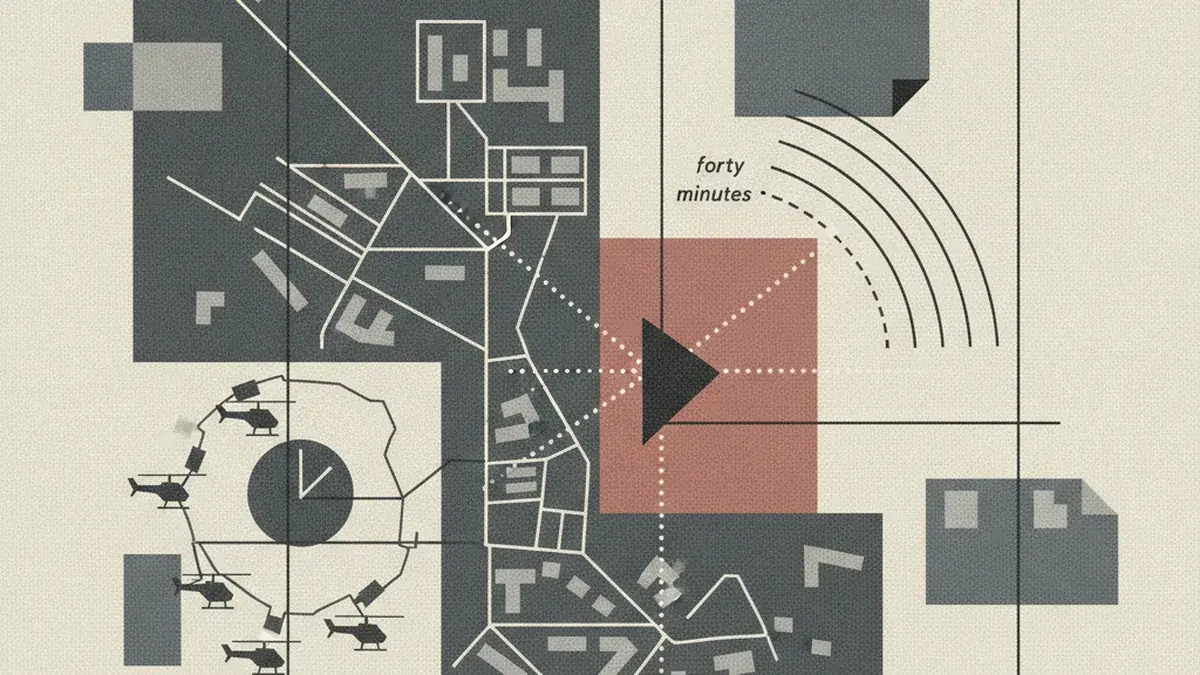
Almost every summary of this event treats it as a single burst of gunfire. It was not. There were three separate engagements, spread over roughly forty minutes, and the arguments about them are different.
| Phase | What happened | Weapon | Main dispute |
|---|---|---|---|
| First | A group of about a dozen men in a street is fired on. At least eight or nine die, including the Reuters photographer. | 30mm cannon | Whether the crew reasonably identified weapons |
| Second | A van stops to pick up a wounded man. It is fired on. The driver and the wounded man die, two children are badly hurt. | 30mm cannon | Whether firing on people collecting the wounded was lawful |
| Third | About half an hour later, three missiles are fired into a partly built residential block. | Hellfire missiles | Proportionality, and who was actually inside |
You can read each phase on its own page: the day itself sets out the sequence, the strike on the van covers the part most lawyers focus on, and the missile strike covers the least-discussed and least-documented phase.
Who died that morning
Most of the men killed in the street have never been publicly named, which tells you something about how this kind of death is recorded. Four people are named in nearly every account.
The four names the record keeps
- Namir Noor-Eldeen, 22, an Iraqi photographer working for Reuters. He was carrying a camera with a long lens.
- Saeed Chmagh, 40, a Reuters driver and assistant, and a father of four. He survived the first burst and was killed in the second.
- Saleh Matasher Tomal, the man who stopped his van to help Saeed Chmagh and was killed doing it.
- Sajad and Doaha Salih, his son and daughter, who were in the front of the van. Both were badly wounded. Both lived.
The people page lists everyone whose name is in the public record, including the soldiers who arrived on the ground afterwards.
The men who were never named
Between six and nine other men died in the first burst. None of them has ever been publicly identified. They appear in the record only as the gap between the lower and upper estimate, which is why every total for that morning is a range rather than a number.
How the footage got out
Reuters asked for the recording the day after its staff were killed, and kept asking for nearly three years using freedom-of-information law. It never received it. That refusal is not a footnote to the story. It is the reason there is a story at all.
In late 2009 and early 2010, a 22-year-old US Army intelligence analyst at a base east of Baghdad found the file on a classified network. She sent it to WikiLeaks along with hundreds of thousands of other documents. Her name then was Bradley Manning; she is now Chelsea Manning. WikiLeaks spent weeks decrypting the file, checking what it showed and sending people to Baghdad to find the families, then published it.
What the Army found, and what it did not do
The US Army investigated in 2007 using an internal process called an AR 15-6. It concluded the aircrew had acted within the rules of engagement, given what they believed they were seeing. That conclusion has never been overturned, and it has never been tested in a criminal court, because no criminal case was ever brought.
Plenty of lawyers and human rights organisations read the same footage and reach a different conclusion, particularly about the van. Disagreement, though, is not a ruling. As things stand, nobody in the aircraft and nobody in the chain of command has faced a charge.
The state of it, in three sentences
- Investigated: yes, internally, within weeks, by the Army itself.
- Cleared: yes, on the basis that the crew followed the rules they were given.
- Tested in court: never, in any country, to this day.
The people who went to prison
Two people were punished in connection with this video, and neither was in the helicopter.
That asymmetry is the thing most people take away from this case, whatever they think about the shooting itself. It is covered in full in the page on accountability.
Why Collateral Murder still matters
Because it changed what people expected to be able to see. Before April 2010, a war was something you were told about. After it, there was a plain example of a government holding a recording that its own citizens turned out to want, and of that recording reaching them anyway.
The pattern it set for every conflict since
It also set a pattern that has repeated in every conflict since: a piece of gunsight or drone footage escapes, everyone argues about the edit, and the argument about the edit slowly replaces the argument about the event. Learning to read this one carefully is good practice for all the others. Start with the frame-by-frame reading, and check anything you are unsure of against the source documents.
A note on this website, because people ask: the address you are reading was used by WikiLeaks for the 2010 release. This archive is independent of that organisation and of everyone else in this story, and it does not host the footage. What it does is keep the record in one place, in order, with the sources attached.
Questions people ask about this
Why is it called Collateral Murder?
Can I watch the video here?
Is this website run by WikiLeaks?
How many people were killed?
Where this comes from
- July 12, 2007, Baghdad airstrike — Wikipedia
- Department of Defense FOIA reading rooms — US Department of Defense
- Reuters news archive — Thomson Reuters
- Iraq Body Count incident records — Iraq Body Count
Spotted something wrong? Tell us and we will fix it.