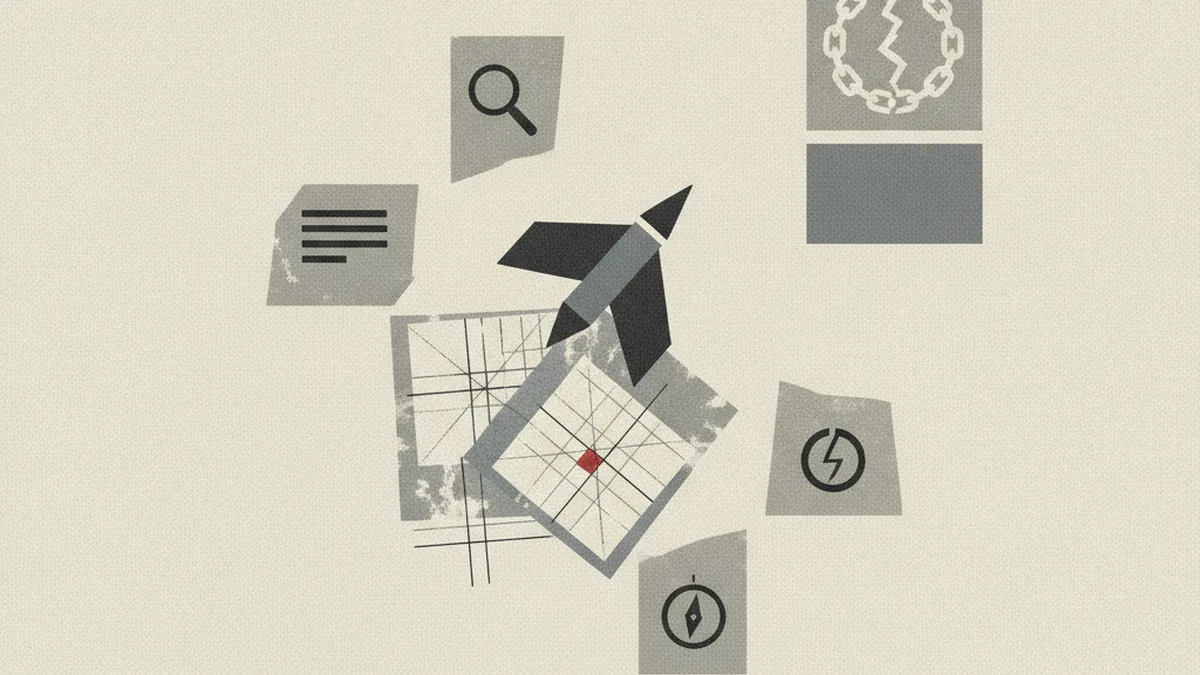
Attribution for an airstrike usually takes years and often never arrives. This one was effectively settled in months, by people outside the government that carried it out, using video, blast analysis and a set of wings.
The missile
Video of the strike was examined by munitions analysts working with Sky News. The weapon was identified from its distinctive wings as a Tomahawk, a US Navy cruise missile.
That identification did most of the work. Israel is not known to operate Tomahawks, so a munition identification alone made the two candidate explanations very unequal. It is unusual for a single technical detail to carry that much weight, and it is why the physical evidence mattered more here than the statements.
The official positions, which did not agree
| Date | Who | Position |
|---|---|---|
| 1 Mar | US Central Command | Aware of reports of civilian harm; protecting civilians is of utmost importance |
| 4 Mar | Secretary of State | Pentagon investigating; the US would not deliberately target a school |
| 4 Mar | Israel Defense Forces | Not aware of any Israeli operation in the region |
| 5 Mar | Two US military personnel, to Reuters | The strike was likely American |
| 7 Mar | The US President | The strike was Iranian, caused by inaccurate Iranian munitions |
| 11 Mar | Pentagon preliminary findings, reported | The US was responsible; outdated coordinates cited |
| 13 Mar | Defense Secretary | Promises a thorough investigation |
The presidential statement on 7 March and the preliminary findings reported on 11 March cannot both be right. Recording that contradiction is not editorialising; it is the plainest fact about the official response.
What the findings said went wrong
The explanation that emerged was not that a school was chosen as a target. It was that the coordinates were out of date, drawn from Defense Intelligence Agency material that no longer described what stood at that location.
The part that is harder to explain
Reporting in July 2026 indicated that military systems had flagged the intelligence as outdated and that those warnings were not acted on. That shifts the character of the failure. A stale coordinate is an error. A stale coordinate that was flagged and overridden is a decision, and it is the difference between an accident and a failure of precaution. Precaution is the rule this bears on.
The independent investigations
- Forensic Architecture with Sky News concluded in July 2026 that all evidence pointed to US responsibility.
- Bellingcat corroborated the attribution.
- The New York Times found the damage pattern too precise for a single stray missile.
- The Washington Post treated the Defense Secretary's statement as a tacit acknowledgement.
Four organisations, different methods, the same answer within about five months. This is the open-source verification field doing the job that the archive's page on checking footage describes, at a scale that did not exist in 2007.
The UN conclusion
What the mission actually said
Established 17 March 2026, reporting 17 September 2026: there were reasonable grounds to believe the two-strike attack was carried out by the United States and that it constituted war crimes. Earlier, in July, UN experts had criticised both Washington and Israel for not publishing their own findings.
"Reasonable grounds to believe" is the standard such missions work to. It is not a criminal verdict and does not pretend to be. It is a finding that the evidence is strong enough to require a prosecution to answer it.
Why attribution took months rather than years
Three things were different from 2007, and they are worth naming because they are not universal.
- The munition was visible. Video showed the weapon in flight, and a cruise missile has a silhouette that narrows the field of possible operators to almost one.
- The site was fixed and civilian. A school has a register, a known footprint and satellite history, so before-and-after comparison is straightforward.
- The verification field exists now. Forensic Architecture, Bellingcat and newsroom investigation teams were not available in this form nineteen years ago.
None of that produced a prosecution. It produced certainty, which is a different thing, and the distance between the two is the subject of most of this archive.
Where the Minab investigation has stopped
No charge. The US Department of Defense inquiry was still open in September 2026, seven months in, run as an AR 15-6 — though convened in the form that permits disciplinary action, which the 2007 Baghdad inquiry was not.
So the position at the end of 2026 is that four independent bodies and a UN mission have reached a conclusion, the government responsible has reached a preliminary one internally and not published it, and nobody has been charged. The 2007 precedent for that process is not encouraging, and the structural reasons are the same ones the rest of this archive documents.
Questions people ask about this
How was the munition identified?
What did the Pentagon conclude?
Did the UN call it a war crime?
Where this comes from
- 2026 Minab school attack — Wikipedia
- UN experts condemn deadly missile strike on girls' school in Iran — UN OHCHR
- Human Rights Watch — Human Rights Watch
Spotted something wrong? Tell us and we will fix it.