Most people who have seen this footage stop paying attention after the van. The recording keeps going for another half hour, and what happens at the end of it may be the least understood thing in the whole case.
What happens
Roughly thirty minutes after the first cannon burst, the same Apache crew report armed men moving into a building a short distance from where the earlier shooting happened. The structure is a partly finished block of flats, concrete frame up, walls incomplete, of a kind that stood on building plots all over Baghdad in 2007.
The building itself
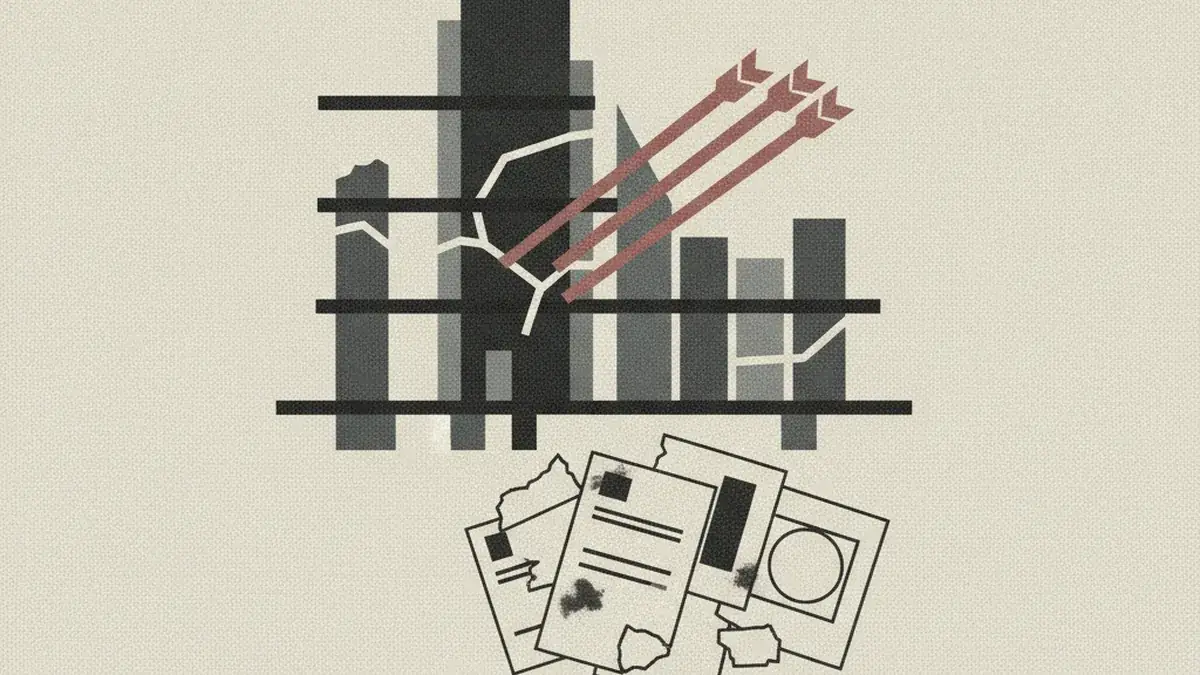
The crew request permission to engage with Hellfire missiles and are cleared. Three missiles are fired, one after another. The building is badly damaged.
The man walking past
Seconds before the first missile arrives, a man walks past on the street in front of the building. He is not running, not carrying anything obvious, and has no idea what is about to happen a few metres away.
What is not known, which is most of it
This phase has never been properly examined in public. The following questions have no settled answer:
| Question | State of the record |
|---|---|
| How many people were inside? | Unknown. Estimates range from a handful to a dozen. |
| Were they armed? | The crew report armed men entering. The footage is too distant to confirm. |
| Were civilians inside? | Never established either way. |
| Who died? | No names have ever been published. |
| Was the building occupied as housing? | Unclear. It was unfinished, which cuts both ways. |
This is why every honest total for the day is a range rather than a number. Counting the dead explains why those ranges exist across the war as a whole.
Why proportionality matters here more than anywhere else
The earlier engagements turn on identification: was that a weapon, was that a rescue. This one turns on a different rule.
What proportionality actually asks
Proportionality asks whether the expected harm to civilians is excessive compared with the military advantage expected from the attack. It does not forbid civilian deaths. It forbids attacks where the likely civilian cost is out of proportion to what is gained.
Why a wall changes the calculation
Fire three anti-armour missiles into a concrete structure on a residential street and you cannot know who is behind the walls. That is not a technicality. It is the whole point of the rule: the less you can see, the more careful you are required to be. The rules of engagement page sets out how that duty was written down for Baghdad in 2007.
Why this phase gets ignored
Three reasons, and none of them is that it does not matter.
- It is at the end. The seventeen-minute edit that most people watched put its weight on the first two engagements, and by the time the missiles are fired the viewer has already formed a view. The difference between the versions is part of this.
- There are no faces. The earlier phases have named victims, a photographer, a driver, children. Here there is a building and a cloud of dust, and it is much harder to write about people whose names nobody recorded.
- There is nothing to check it against. With no names and no separate account, there was never a story for a reporter to follow up.
The result is a strange gap in the record. The most destructive act of that morning is the one we know least about.
A gap worth naming
The most destructive act of that morning produced the least documentation, the least reporting and the least argument. Three missiles, an unknown number of dead, and no names. Absence of attention is not the same as absence of importance.
What a proper inquiry would have asked
A serious examination of this phase would have needed to establish who was in the building, on what basis they were assessed as armed, what alternatives the crew and their commanders considered, and what the anticipated harm to anyone else nearby was judged to be. None of that is public.
The Army's internal inquiry covered the morning as a whole and found the crews acted within their rules, but an administrative investigation of that kind is not built to answer a proportionality question about one strike. What the investigation did and did not do is worth reading before assuming it settled anything here.
The missile strike is the quietest part of the record
There is something uncomfortable about the fact that the loudest event of the morning produced the smallest amount of argument. The first burst has been frozen, zoomed and debated frame by frame for fifteen years. The van has been picked over by lawyers. The building got three missiles and a shrug.
Partly that is because the video is a bad witness here and there is genuinely little to see. Partly it is because a story needs people in it, and this phase never got any. If the archive can do one useful thing with this page, it is to leave the question open rather than let it close by neglect. Anyone who knows of a public record covering what happened in that building is asked to send it to us.
Questions people ask about this
How many people died in the missile strike?
Was the building occupied?
Why do so few accounts mention it?
Where this comes from
- Rules on proportionality in attack — International Committee of the Red Cross
- July 12, 2007, Baghdad airstrike — Wikipedia
- Iraq Body Count — Iraq Body Count project
Spotted something wrong? Tell us and we will fix it.