Nagasaki is the harder of the two to write about, for a reason that has nothing to do with scale. It was not supposed to be Nagasaki, and the second bomb fell before anyone had established what the first had done.
What happened
At 11:02 on 9 August 1945, a US B-29 released a plutonium implosion bomb over Nagasaki. It detonated about 500 metres above the Urakami valley with a yield of roughly 21 kilotons, appreciably larger than the Hiroshima weapon.
The district beneath it was destroyed. As at Hiroshima, deaths came first from blast and burns, then over weeks and months from injuries and radiation-related illness.
Nagasaki was not the target
The primary target that morning was Kokura. The aircraft made several runs over it and could not see the aiming point through cloud and smoke drifting from a city bombed the day before. Running low on fuel, it turned to its secondary target.
Tens of thousands of people in Kokura lived because of the weather, and tens of thousands in Nagasaki died because of it. There is no framework in this archive that makes sense of that.
The toll
Why a bigger bomb killed fewer people
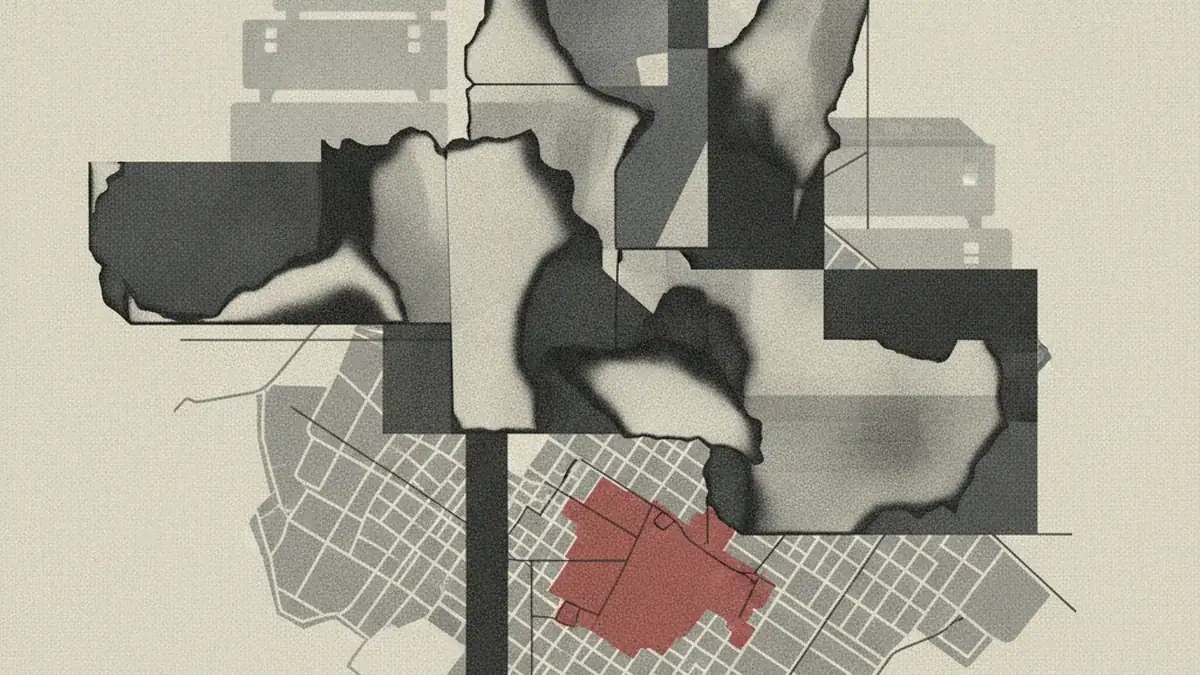
Nagasaki sits among hills. The weapon detonated over a valley, and the ridges confined much of the blast and heat to the Urakami district rather than letting it spread across the whole city. Hiroshima, by contrast, is flat and the effects propagated outward with little to stop them.
Terrain, not restraint, accounts for the difference. The same point appears throughout this index: outcomes depend on where a weapon lands as much as on what it is.
- The aircraft takes off with Kokura as its primary target.
- Three runs over Kokura; cloud and smoke obscure the aiming point.
- The weapon detonates over the Urakami valley at Nagasaki.
- 60,000 to 80,000 dead, about 74,000 commonly cited.
For how figures like these are arrived at and why they are given as ranges, see the page on counting the dead and the index as a whole.
The three days in between
This is the part specific to Nagasaki. When the second bomb fell, nobody outside Hiroshima had a reliable account of what the first had done. Communications were destroyed, the Japanese government was still establishing the scale, and the interval was too short for the effect of one to inform the decision about the other.
The question that follows
A decision to use a second weapon before the first has been assessed is a decision taken without the information it needed. Whether that changes the moral weight is a genuine argument, and this archive does not resolve it. It records that the interval was three days.
Which category this belongs in
The same third column as Hiroshima: an attack in which the city was the target. Nagasaki had major shipyards and arms works, and they were real military industry. They were also embedded in a populated valley, and a 21-kiloton weapon does not distinguish between them.
Not collateral damage, because civilians were not incidental. Not a massacre in the My Lai sense, because no one was killed face to face. The index explains why the third category exists.
The test this archive applies
Ask what was the object of the attack. At Kunduz it was a building the crew misidentified. At My Lai it was the people themselves, at arm's length. At Nagasaki it was the district, and everyone in it was inside the answer.
What stood in the Urakami valley
One detail is worth recording because it cuts against how this event is usually framed as a clash of civilisations.
Urakami was the historic centre of Japanese Catholicism, home to the largest cathedral in East Asia and to a community that had survived centuries of persecution. The weapon detonated almost above it. A very large share of that community was killed in the instant.
The point is not that those deaths counted differently from the others. It is that a weapon with an effect radius measured in kilometres does not select among the people underneath it, which is precisely why the category this page sits in exists at all.
What Nagasaki adds that Hiroshima does not
Hiroshima can be argued about as a single decision with a stated purpose. Nagasaki is harder, because it introduces contingency at every level: the wrong city, chosen by cloud cover, three days into an assessment nobody had finished, with a weapon whose effects were shaped by the shape of a valley.
That combination is a useful corrective to how these events are usually discussed. The decisions that produce the largest civilian death tolls are not always the most deliberate ones, and the question of who answers for them gets no easier when the answer involves the weather.
Questions people ask about this
How many died at Nagasaki?
Why was Nagasaki bombed instead of Kokura?
Why did a larger bomb kill fewer people than at Hiroshima?
Where this comes from
- Atomic bombings of Hiroshima and Nagasaki — Wikipedia
- Counting the dead at Hiroshima and Nagasaki — Bulletin of the Atomic Scientists
- Hiroshima and Nagasaki bombings — ICAN
Spotted something wrong? Tell us and we will fix it.